
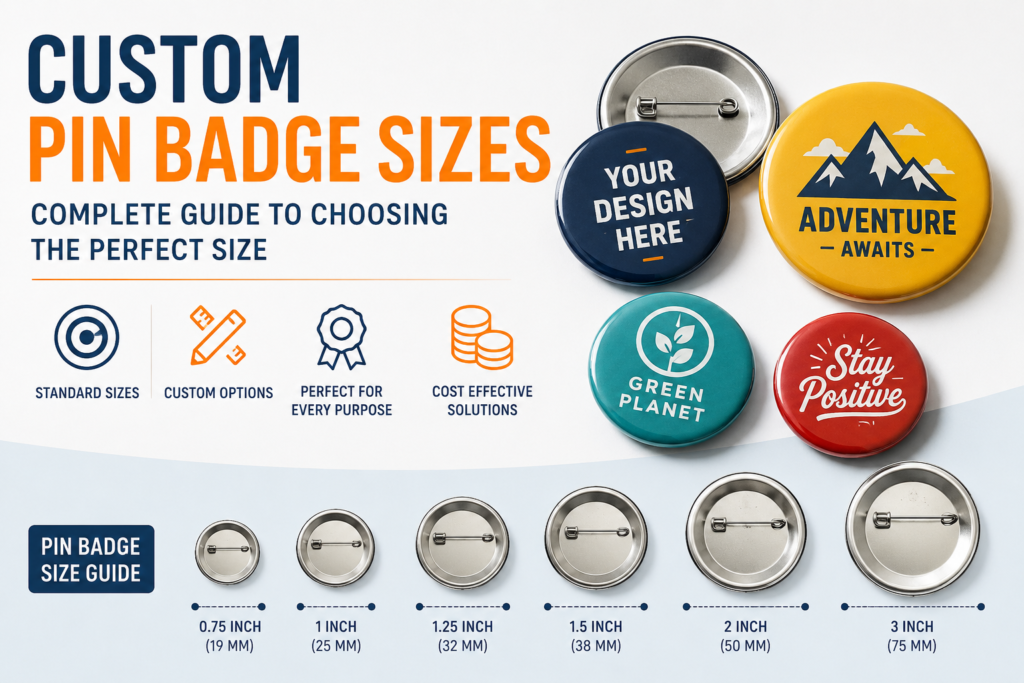
Custom pin badges have become one of the most powerful tools for branding, marketing, personal expression, and event identity. From corporate giveaways to fashion accessories and political campaigns, pin badges are everywhere. But one of the most overlooked yet most important factors in designing them is custom pin badge size.
Choosing the right size is not just about aesthetics—it directly affects visibility, cost, usability, and print quality. In this guide, we will explore everything you need to know about custom pin badge sizes, including standard dimensions, use cases, design tips, and how to select the perfect size for your purpose.
Why Custom Pin Badge Size Matters
The size of a pin badge impacts multiple aspects of its effectiveness. A poorly chosen size can make even the best design look unprofessional or hard to read.
Here’s why size matters:
A larger badge improves visibility and detail clarity, making it ideal for branding or promotional events. Smaller badges, on the other hand, are subtle and stylish, often used for fashion or minimalist branding.
Size also affects cost. Larger badges require more material, which increases production cost. Meanwhile, smaller badges are cost-effective but may limit design detail.
Most importantly, the size influences how your audience perceives your brand. A well-proportioned badge creates a professional and memorable impression.
Standard Custom Pin Badge Sizes
Although custom pin badges can be made in almost any size, there are industry-standard dimensions that manufacturers commonly follow.
1. Small Pin Badges (0.75 inch – 1 inch)
These are compact and minimalistic. They are often used for subtle branding, uniforms, or fashion accessories.
Use cases:
- Corporate uniforms
- Minimal branding
- Fashion wear
- Collectible sets
Small badges are lightweight and affordable but may not support detailed artwork.
2. Medium Pin Badges (1.25 inch – 1.75 inch)
This is the most popular size range in the market. It provides a perfect balance between visibility and cost.
Use cases:
- Promotional giveaways
- School and college events
- NGO campaigns
- Brand merchandise
Medium badges allow better design clarity and are suitable for logos and simple illustrations.
3. Large Pin Badges (2 inch – 3 inch)
Large badges are designed for maximum visibility and strong visual impact.
Use cases:
- Event branding
- Political campaigns
- Awareness campaigns
- Collector editions
These badges allow detailed artwork, gradients, and complex designs but cost more.
4. Extra Large Custom Badges (3+ inch)
These are not very common but are used for special purposes.
Use cases:
- Award badges
- Premium collector items
- Special promotions
They are highly visible but less practical for daily wear due to their size.
How to Choose the Right Custom Pin Badge Size
Selecting the right size depends on your purpose, audience, and design requirements. Here are the key factors to consider:
1. Purpose of the Badge
If your goal is branding or promotion, medium to large sizes are ideal. For fashion or subtle branding, smaller sizes work better.
2. Design Complexity
If your design includes detailed illustrations, gradients, or small text, choose a larger badge. Small badges may distort or lose detail.
3. Budget Considerations
Smaller badges are more affordable. Larger badges increase material and production costs.
4. Audience and Usage
For corporate audiences, medium-sized professional badges work best. For youth or casual use, trendy small badges are more appealing.
5. Visibility Requirement
If your badge needs to be seen from a distance—such as at events or campaigns—go for larger sizes.
Material and Shape Influence on Size
Pin badge size also interacts with material and shape. For example, metal badges tend to look more premium even in smaller sizes, while acrylic badges may require slightly larger dimensions for clarity.
Shapes like circular and square are easier to standardize, while custom shapes (die-cut designs) may require size adjustments to maintain balance.
Design Tips for Different Badge Sizes
To ensure your badge looks professional regardless of size, follow these design principles:
For small badges, keep designs simple with bold colors and minimal text. Avoid intricate details.
For medium badges, you can include logos, icons, and short text comfortably.
For large badges, take advantage of full creative freedom—use gradients, illustrations, and layered design elements.
Always ensure contrast is strong so your design remains visible even from a distance.
Printing Considerations for Pin Badge Sizes
Printing quality is heavily affected by badge size. High-resolution files (300 DPI or higher) are recommended for all sizes.
Smaller badges require simplified designs because fine details may not print clearly. Larger badges allow more flexibility but must maintain sharp resolution to avoid pixelation.
Color mode also matters—CMYK is preferred for print accuracy.
Common Mistakes to Avoid
Many businesses and designers make mistakes when selecting pin badge sizes:
One common mistake is choosing a size that is too small for a detailed logo, resulting in unreadable designs.
Another mistake is oversizing the badge without considering usability, making it uncomfortable to wear.
Ignoring target audience preferences is also a frequent issue, especially in promotional campaigns.
Conclusion
Choosing the right custom pin badge size is a crucial step in creating effective branding and promotional materials. Whether you need small subtle badges or large impactful designs, understanding size options helps you balance visibility, cost, and design clarity.
By selecting the correct dimensions and working with a professional manufacturer, you can ensure your pin badges not only look great but also deliver strong branding impact.
If you are planning your next campaign or merchandise collection, start by identifying your purpose, audience, and design needs—and then choose the perfect badge size accordingly
FAQ
The most common custom pin badge sizes are 0.75 inch to 3 inches. Small badges (0.75–1 inch) are used for minimal branding, medium sizes (1.25–1.75 inch) are most popular for promotions, and large badges (2–3 inch) are used for high visibility campaigns and events.
The best size for custom pin badges is usually 1.25 to 1.75 inches because it offers a balance between visibility, cost, and design clarity. This size works well for logos, branding, and promotional giveaways.
For detailed artwork, gradients, or small text, a larger size such as 2 inches or above is recommended. Bigger badges provide more space, ensuring the design remains clear and professional.
Yes, smaller pin badges are generally more affordable because they use less material and require simpler production. Larger badges cost more due to increased material, printing area, and finishing work.