
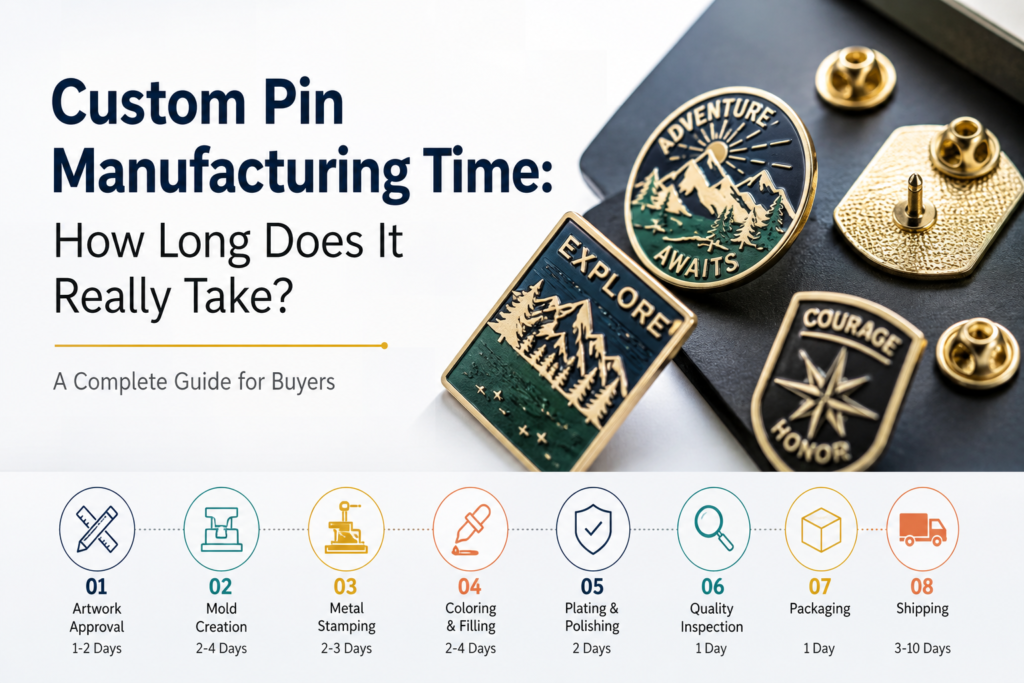
Ordering custom pins is exciting, whether you are designing promotional giveaways, company badges, school awards, military challenge coins, or collectible enamel pins. However, one of the biggest questions buyers ask before placing an order is about custom pin manufacturing time. Understanding how long the production process takes helps businesses plan product launches, marketing campaigns, exhibitions, employee recognition programs, and special events without unnecessary delays.
The reality is that manufacturing custom pins involves much more than simply printing a design onto metal. Every order passes through several production stages, from artwork approval and mold creation to coloring, polishing, plating, quality inspection, packaging, and shipping. Each step contributes to the final production timeline.
This guide explains every stage of custom pin manufacturing, the factors that influence production speed, and practical ways to receive your custom pins faster without compromising quality.
Why Understanding Custom Pin Manufacturing Time Matters
Many buyers assume custom pins can be produced within a few days. While rush services are available, standard manufacturing usually takes between 10 and 20 business days, depending on the complexity of the design and order quantity.
Knowing the estimated timeline helps businesses:
- Plan marketing campaigns
- Meet event deadlines
- Schedule product launches
- Avoid expensive rush orders
- Reduce last-minute stress
Professional manufacturers always recommend ordering several weeks before your required delivery date.
Average Custom Pin Manufacturing Timeline
Although every project is unique, the average production schedule looks like this:
| Production Stage | Estimated Time |
|---|---|
| Artwork Review | 1 Day |
| Digital Proof Approval | 1–2 Days |
| Mold Creation | 2–4 Days |
| Metal Stamping | 2–3 Days |
| Coloring & Filling | 2–4 Days |
| Plating & Polishing | 2 Days |
| Quality Inspection | 1 Day |
| Packaging | 1 Day |
| Shipping | 3–10 Days |
Overall manufacturing usually requires 10–20 business days, excluding international shipping delays.
>Best Uses of Custom Pins for Businesses: Powerful Branding & Marketing Tool
>3D Lapel Pin Artwork Secrets Every Designer Needs
Step 1: Artwork Preparation
Everything starts with your artwork.
Professional manufacturers convert your logo or illustration into a production-ready vector design. During this stage, designers adjust line thickness, color separation, border dimensions, and pin size.
If revisions are needed, production pauses until final approval is received.
Submitting high-quality vector files like AI, EPS, or PDF significantly reduces delays.
Step 2: Digital Proof Approval
Before manufacturing begins, you’ll receive a digital proof showing:
- Final size
- Colors
- Metal finish
- Pin backing
- Border details
- Text placement
Production cannot begin until you approve the artwork.
Many delayed orders occur simply because customers take several days to review their proofs.
Step 3: Mold Manufacturing
The mold is one of the most important parts of custom pin production.
Manufacturers engrave a hardened steel mold based on your approved artwork. Every metal pin is stamped using this mold.
Complex artwork containing intricate details or multiple layers requires additional machining time.
Since every design requires its own mold, first-time orders generally take longer than repeat orders.
Step 4: Metal Stamping
Once the mold is complete, manufacturers stamp the pin shape into metal sheets using high-pressure machinery.
Different metals require different production methods:
Soft Enamel Pins
These are faster to manufacture because raised metal borders separate the enamel colors.
Hard Enamel Pins
These require additional polishing after enamel filling, making production slightly longer.
Die Struck Pins
Since no enamel coloring is required, production may be slightly faster depending on the finish.
Step 5: Coloring and Enamel Filling
This stage is where custom pins truly come to life.
Each color is carefully filled by hand or automated equipment depending on the production facility.
Pins with:
- More colors
- Gradient effects
- Glitter
- Glow enamel
- Transparent enamel
- Screen printing
- Epoxy coating
require additional production time.
Simple two-color designs naturally finish much faster than highly detailed collectible pins.
Step 6: Baking and Drying
After enamel filling, pins are baked in industrial ovens.
This hardens the enamel and ensures long-lasting durability.
Hard enamel pins may require multiple polishing cycles to achieve their perfectly smooth surface.
This extra finishing process is why hard enamel usually has a slightly longer production schedule.
Step 7: Metal Plating
Pins receive their selected metal finish after polishing.
Popular finishes include:
- Gold
- Silver
- Black Nickel
- Antique Brass
- Antique Copper
- Rose Gold
Each plating option undergoes careful inspection to ensure an even, premium-quality finish.
Step 8: Quality Control
Professional manufacturers inspect every batch before packaging.
Inspectors verify:
- Color accuracy
- Proper plating
- Secure pin backing
- Smooth enamel
- Correct dimensions
- Sharp engraving
- Scratch-free surface
Quality control prevents defective products from reaching customers.
Step 9: Packaging
Pins are packaged according to customer requirements.
Popular packaging options include:
- Poly bags
- Velvet boxes
- Display cards
- Custom backing cards
- Gift boxes
Custom retail packaging may add one or two extra production days.
Step 10: Shipping
Shipping time depends entirely on your selected delivery method.
Express courier services typically arrive within 3–5 business days, while standard international shipping can require 7–14 business days.
Always include shipping time when calculating your total project timeline.
Factors That Affect Custom Pin Manufacturing Time
Every custom pin project is different.
Several factors influence how quickly your order can be completed.
Design Complexity
Detailed artwork containing multiple colors, tiny text, gradients, or screen printing naturally requires additional production time.
Simple logo pins usually finish much faster.
Quantity Ordered
Large bulk orders require longer production schedules than smaller quantities.
However, experienced manufacturers often produce thousands of pins efficiently through automated production lines.
Pin Size
Larger pins consume more metal, enamel, and polishing time.
Smaller pins typically move through production more quickly.
Pin Type
Soft enamel pins are generally the fastest.
Hard enamel pins require additional polishing.
Die struck pins may be quicker depending on the finish.
Spinner, sliding, LED, bottle opener, and hinged pins often require extra assembly.
Metal Finish
Standard gold and silver finishes usually complete faster than antique or specialty finishes.
Packaging Requirements
Custom printed packaging, backing cards, and retail boxes add finishing time.
Can You Get Rush Custom Pin Manufacturing?
Yes.
Most professional manufacturers offer rush production services.
Rush manufacturing typically reduces production to 5–8 business days, depending on design complexity and factory workload.
Rush orders often include:
- Priority artwork review
- Faster mold production
- Production queue priority
- Express shipping
Although rush services cost more, they are ideal for trade shows, product launches, conferences, and corporate events.
How to Reduce Custom Pin Manufacturing Time
One of the easiest ways to speed up production is by submitting production-ready artwork.
Respond quickly to proof approvals and avoid requesting design revisions after manufacturing begins.
Choosing standard metal finishes, simple shapes, and common pin sizes also shortens production time.
Ordering well before your event deadline gives manufacturers enough flexibility to maintain excellent quality.
Should You Order Early?
Absolutely.
Industry professionals recommend placing custom pin orders at least 4–6 weeks before your event.
Ordering early provides enough time for artwork revisions, manufacturing, quality inspection, shipping, and unexpected delays.
Early planning also eliminates expensive rush fees.
Choosing the Right Manufacturer
The manufacturer you choose directly affects production speed.
Look for suppliers that provide:
- Transparent production timelines
- Free artwork revisions
- Fast communication
- Quality guarantees
- Positive customer reviews
- Modern manufacturing equipment
- Worldwide shipping
Reliable manufacturers consistently deliver accurate timelines without sacrificing product quality.
Conclusion
Understanding Custom Pin Manufacturing Time helps buyers make informed purchasing decisions and avoid costly delays. While standard production usually takes 10–20 business days, the actual timeline depends on artwork complexity, order quantity, manufacturing methods, packaging, and shipping.
Planning ahead, approving artwork promptly, and partnering with an experienced manufacturer ensures your custom pins arrive on time and meet the highest quality standards. Whether you need promotional lapel pins, corporate badges, collectible enamel pins, or event merchandise, allowing sufficient production time guarantees a smooth ordering experience.
Frequently Asked Questions
Most custom pin orders require 10–20 business days for manufacturing, plus shipping time.
Yes. Many manufacturers offer rush production services that can complete orders in 5–8 business days, depending on design complexity.
Artwork revisions, delayed proof approvals, complex designs, custom packaging, and international shipping are the most common causes of delays.
Yes. Hard enamel pins require additional polishing, which increases production time slightly.